
Article Sidebar
Downloads
Main Article Content
Abstract
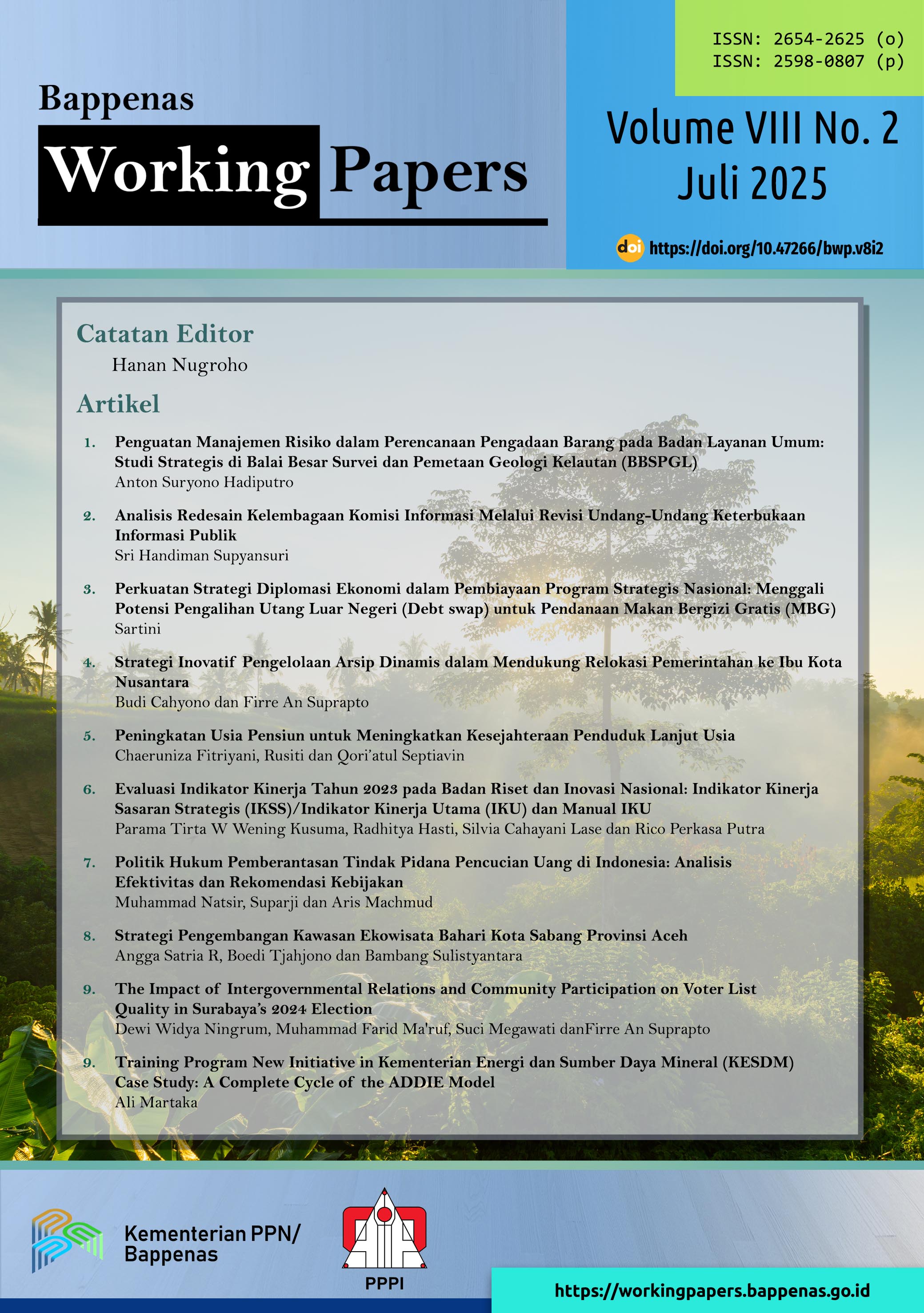
Pembiayaan Makan Bergizi Gratis (MBG) berpotensi memperburuk defisit anggaran dan meningkatkan ketergantungan pada utang, khususnya yang bersumber dari luar negeri. Kondisi ini mengharuskan pemerintah mengadopsi strategi inovatif dalam pembiayaan publik. Melalui analisis kebijakan yang dilakukan ditunjukkan bahwa Bilateral Debt Swap adalah alternatif paling feasible melalui pembobotan MDCA dengan negara kreditur seperti Tiongkok yang memiliki posisi strategis dalam peta diplomasi ekonomi Indonesia. Skema ini menawarkan fleksibilitas dalam penggunaan dana serta minim risiko politik dan ekonomi, dibandingkan opsi tri-party atau private debt swap. Setelah mengkaji, tulisan ini merekomendasikan agar Pemerintah melalui K/L terkait melakukan negosiasi dengan mengintegrasikan skema Bilateral Debt Swap pada strategi diplomasi serta pengelolaan utang luar negeri. Namun demikian, strategi ini memerlukan dukungan kerangka regulasi, mencakup tata kelola transparan, pengawasan multistakeholder, serta sinkronisasi kebijakan lintas sektor agar manfaat ekonomi dan sosial dapat dimaksimalkan. Dengan pendekatan yang terstruktur dan berbasis evidence, debt swap for school meal ini berpotensi menjadi model baru diplomasi ekonomi Indonesia yang tidak hanya memperkuat stabilitas fiskal, tetapi juga mendukung investasi jangka panjang pada peningkatan kualitas sumber daya manusia.
Keywords
Article Details

This work is licensed under a Creative Commons Attribution-NonCommercial-ShareAlike 4.0 International License.
This is an open-access article distributed under the terms of the Creative Commons Attribution-NonCommercial-ShareAlike 4.0 International License. Copyright © Bappenas Working Papers
References
- Acker, K., Bräutigam, D., & Huang, Y. (2020). Debt Relief with Chinese Characteristics. SSRN Electronic Journal. https://doi.org/10.2139/ssrn.3745021
- Armstrong, C. S., Guay, W. R., & Weber, J. P. (2010). The role of information and financial reporting in corporate governance and debt contracting. Journal of Accounting and Economics, 50(2–3), 179–234. https://doi.org/10.1016/j.jacceco.2010.10.001
- Atun, R., Silva, S., Ncube, M., & Vassall, A. (2016). Innovative financing for HIV response in sub–Saharan Africa. Journal of Global Health, 6(1). https://doi.org/10.7189/jogh.06.010407
- Cassimon, D., Essers, D., & Fauzi, A. (2014). Indonesia’s Debt-for-Development Swaps: Past, Present, and Future. Bulletin of Indonesian Economic Studies, 50(1), 75–100. https://doi.org/10.1080/00074918.2014.896238
- Esteves, R. P., & Tunçer, A. C. (2016). Eurobonds Past and Present: A Comparative Review on Debt Mutualization in Europe. Review of Law & Economics, 12(3). https://doi.org/10.1515/rle-2016-0047
- Ferry, M., & Raffinot, M. (2019). Curse or Blessing? Has the Impact of Debt Relief Lived up to Expectations? A Review of the Effects of the Multilateral Debt Relief Initiatives for Low-Income Countries. The Journal of Development Studies, 55(9), 1867–1891. https://doi.org/10.1080/00220388.2018.1499895
- Froese, H., Hoefer, M., & Wilhelmi, L. (2023). The Complexity of Debt Swapping. http://arxiv.org/abs/2302.11250
- Ibrahim, M. R., Sukandar, R., & Nusantari, L. A. (2023). Indonesia’s Economic Advancement through Leveraging the Geopolitical Rivalry and Geostrategic between the USA and China in the Indo-Pacific Region. Jurnal Pertahanan: Media Informasi Ttg Kajian & Strategi Pertahanan Yang Mengedepankan Identity, Nasionalism & Integrity, 9(2), 379. https://doi.org/10.33172/jp.v9i2.8823
- Kumar, P., Debele, S. E., Sahani, J., Rawat, N., Marti-Cardona, B., Alfieri, S. M., Basu, B., Basu, A. S., Bowyer, P., Charizopoulos, N., Jaakko, J., Loupis, M., Menenti, M., Mickovski, S. B., Pfeiffer, J., Pilla, F., Pröll, J., Pulvirenti, B., Rutzinger, M., … Zieher, T. (2021). An overview of monitoring methods for assessing the performance of nature-based solutions against natural hazards. Earth-Science Reviews, 217, 103603. https://doi.org/10.1016/j.earscirev.2021.103603
- Nugroho, H. Y. S. H., Indrajaya, Y., Astana, S., Murniati, Suharti, S., Basuki, T. M., Yuwati, T. W., Putra, P. B., Narendra, B. H., Abdulah, L., Setyawati, T., Subarudi, Krisnawati, H., Purwanto, Saputra, M. H., Lisnawati, Y., Garsetiasih, R., Sawitri, R., Putri, I. A. S. L. P., … Rahmila, Y. I. (2023). A Chronicle of Indonesia’s Forest Management: A Long Step towards Environmental Sustainability and Community Welfare. Land, 12(6), 1238. https://doi.org/10.3390/land12061238
- Panizza, U., Sturzenegger, F., & Zettelmeyer, J. (2009). The Economics and Law of Sovereign Debt and Default. Journal of Economic Literature, 47(3), 651–698. https://doi.org/10.1257/jel.47.3.651
- Rimbawan, R., Nurdiani, R., Rachman, P. H., Kawamata, Y., & Nozawa, Y. (2023). School Lunch Programs and Nutritional Education Improve Knowledge, Attitudes, and Practices and Reduce the Prevalence of Anemia: A Pre-Post Intervention Study in an Indonesian Islamic Boarding School. Nutrients, 15(4), 1055. https://doi.org/10.3390/nu15041055
- Swanson, E., Nedopil, C., Yue, M., Niu, R., & Zhu, L. (2022). Debt for Nature Swap - A Green Finance Tool for Dealing with Overseas Foreign Debt. https://doi.org/10.13140/RG.2.2.10718.31041
- Trebesch, C., Das, U., & Papaioannou, M. (2012). Sovereign Debt Restructurings 1950-2010. IMF Working Papers, 2012(203), 1. https://doi.org/10.5089/9781475505535.001
- Wei, C., McCormack, G., & Zhao, J. (2023). Bargaining in the shadow of law and finance: the market-oriented debt to equity swap in China. Journal of Corporate Law Studies, 23(2), 601–632. https://doi.org/10.1080/14735970.2024.2301818
- Zhang, F., Hu, X., Tian, Z., Zhang, Q., & Ma, G. (2015). Literature research of the Nutrition Improvement Programme for Rural Compulsory Education Students in China. Public Health Nutrition, 18(5), 936–943. https://doi.org/10.1017/S1368980014001001